In course lectures, assigned textbooks, and student theses, YSM perpetuated contemporary racist beliefs.
- Professors mentioned racial differences in course lectures and assumed that race and skin color affected illness and treatments.
- Assigned textbooks also taught students about race, suggesting that Black people could not get certain diseases, such as malaria and yellow fever.
- Students often repeated these lessons in their MD theses, showing that they accepted race as an important medical category.
- Some students chose not to discuss racial differences, demonstrating that mentioning them was a choice and not required for professional acceptance.
Continue Reading to Learn More
In the 1830s, the Medical Institution’s Professor of Surgery and Obstetrics, Thomas Hubbard, routinely paused his lecture on tumors and enlargements of male genitalia to comment on a seemingly unrelated topic. He paused to describe “The Hottentots in Africa” as having “great enlargements of the female mammae” (meaning breasts) that allowed them to “nurse their infants when tied to their backs.” He then explained that “They are said also to have surprizing enlongations of the Nymphae [labia minora].”


As historian Jennifer Morgan has explained, Europeans had been racializing Africans by referencing their supposedly monstrous sexual characteristics since the sixteenth century. The trope of African women having elongated breasts that let them nurse children tied to their backs would have been well-known to Hubbard and his students, and the fact that Hubbard mentioned it in passing reinforces its widespread acceptance.
Mentioning that rumored trait in a medical lecture, however, also made it a medical fact supported by Hubbard’s authority as a professor at the medical school, then called the Medical Institution of Yale College. Earlier, in the Middle Ages, traits such as elongated breasts and labia were thought to be signs of monstrosity, a corruption of God’s design. In the early modern era, these kinds of traits also became signs of racial differences traits, and by including them in his lecture, Hubbard reinforced the idea that elongated breasts and labia were medically recognized racial African traits. Furthermore, by mentioning “Hottentot” women’s supposedly elongated labia in a lecture otherwise about enlarged male genitalia requiring medical intervention, Hubbard gestured to a connection. The juxtaposition perhaps suggested that enlarged female genitalia meant the women were unnaturally male or bestial or that enlarged labia were a medical problem requiring surgery like tumors on penises and scrotums. Either way, Hubbard’s description reinforced ideas of sexual difference, and he used them in a specifically racial context, implying that differently racialized people had medically different bodies.
As shocking as Hubbard’s out-of-nowhere remark about “Hottentot” breasts and labia are, they were part of larger trend of medical professors, students, and textbooks reinforcing and furthering common assumptions that bodily, medical differences existed between people of different races. Histories of race have traditionally described “scientific racism” as emerging in the1820s and 1830s, as part of physical anthropology. However, newer studies of race and medicine have revealed that physicians and surgeons were already assuming that race mattered in people’s susceptibility to diseases and in their responses to medical treatment by the 1780s. Rana A. Hogarth, for instance, has traced how physicians and surgeons came to believe that a patient’s race might make them invulnerable to diseases like yellow fever or that race itself was a pathology leading to behaviors such as dirt eating.
Early anthropologists measured different human body parts in an effort to define the differences between different races. They were especially fond of measuring skulls, including the “facial angle” and skulls’ volumes both of which they supposed related to brain size and thus intelligence. Racial anthropologists also argued about whether the races they perceived were the products of one creation (called “monogenism”) or whether the races were created separately (“polygenism”). These techniques and arguments informed political debates over slavery and Black citizenship, though whether an anthropologist declared themselves to be a monogenist or polygenist, the idea that humans differed according to their race routinely assumed and supported white supremacy.
Medical schools, including Yale’s, played an active role in disseminating scientific theories about racial differences. As historian Christopher D. E. Willoughby has shown recently, medical students learned about racial theories in lectures and from textbooks, and they repeated these ideas in the theses they were often required to write to earn their MD. They also spread these ideas through national and international networks of correspondence and publishing as well as in their medical practices throughout the United States and beyond.
At the Medical Institution of Yale College, assigned textbooks stressed aspects of anatomy that supposedly defined differences between human races. Polygenist Joseph Leidy’s An Elementary Treatise on Human Anatomy, for instance, stated that the brain “is the largest in the white race; and, all other circumstances being equal… its bulk bears a general relationship with the development of intellect.” Leidy also explained that this capacity was related to skull shape, explaining that “The angle of inclination of the fore part of the skull is viewed to determine… in some measure to form an estimate of the mental capacity of races and individuals.” Leidy rooted white people’s supposed intellectual superiority in the physical body, portraying intellect as a fixed racial trait, and Yale students would have learned these lessons in racial difference as they read about the structures of the human body.
Leidy’s text went further than just supporting a white supremacist view of intellect. It also suggested that Black people smelled due to their physical makeup. Leidy explained “the odiferous glands of the axilla [armpits]… are usually much better developed in the negro, in whom the largest reach the size of a small pea,” from which he concluded that “these glands yield a strongly odorous substance, which is somewhat peculiar in the different races.” Again, Leidy conveniently supported white notions of their own supremacy in a supposed anatomical difference, which Yale students were then expected to read and regurgitate.
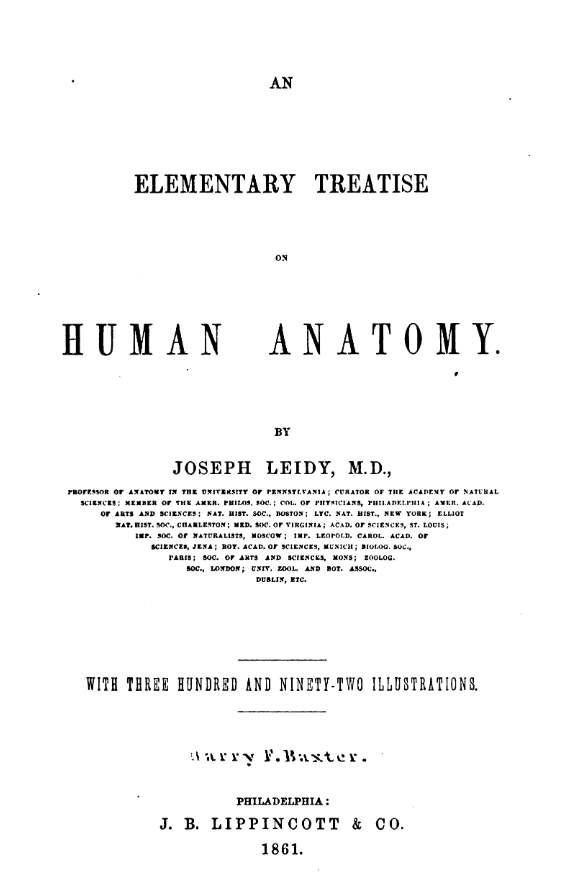
No nineteenth-century Yale faculty members were famed as polygenists like University of Pennsylvania’s Joseph Leidy or Harvard University’s Louis Agassiz, but assumptions of racial difference could also be found regularly in the curriculum outside of anatomy. In lectures, Yale professors assumed that white bodies were normal, only pointing out patients’ races when they were not white. They also regularly commented that people of different races could or could not catch specific diseases or were more or less affected by them. Assigned textbooks repeated and added to these lists of race-specific diseases and reactions. Sometimes professors and textbooks mentioned that therapies and cures, too, differed according to a patients’ race. Textbooks, especially anatomical ones, referenced racial anthropology and measurements to provide a basis in the body for these differing racial illnesses and treatments.
One disease that was commonly associated with the West Indies and thereby slavery and African ancestry was tetanus, or lockjaw. During the Yale School of Medicine’s first year offering courses in the winter or 1813 – 1814, Nathan Smith mentioned in a lecture that lockjaw was “a disease peculiar to warm climates; this disease is not frequent in this climate, but is very frequent in the West Indies.” Smith did not mention race or slavery but implied a connection by mentioning the West Indies. A few years later, he made the connection explicit, explaining that “the children of the blacks [in the West Indies] have it [lockjaw] from the retention – of the meconium.” “Mecanium,” or “meconium” today, is a baby’s first poop and is usually very dark, thick, and sticky. In an 1830 lecture, Smith’s colleague Eli Ives repeated the idea that “retention of the meconium” contributed to “trismuz,” more commonly called “lock jaw,” being “very common in the West Indies Islands.” Neither Ives nor Smith directly stated that Black West Indians’ race led them to develop tetanus or made them more susceptible to it, but by framing the disease in terms of Black West Indians being more commonly afflicted, they implied race mattered while they overlooked enslaved people’s living and working conditions as a potential factor.
Smith, Ives, and their contemporaries may have been right that enslaved people in the West Indies developed lockjaw at higher rates than patients closer to home in Connecticut, but this would have been due to their different living conditions and not their race. The bacteria that cause tetanus live in soil and manure, and it often enters the body through puncture wounds. Black West Indians could have been especially vulnerable to tetanus because their owners rarely supplied them with shoes and because the sugar fields where their enslavers forced them to work were regularly fertilized with manure, meaning cuts from the long, sharp sugar cane leaves would have been common and easily infected. Babies can be exposed when their umbilical cord is cut with a contaminated knife. While tetanus causes muscle spasms that can lead to constipation, it takes on average over a week to develop symptoms, suggesting that the stricken babies were born with the disease rather than acquired it from the cutting of their umbilical cord.
A textbook assigned to Yale medical students in the 1860s and produced after slavery had ended in the British Caribbean made a more explicit case for the importance of race to tetanus. Going further than Smith and Ives, the textbook claimed “the negro is more disposed to tetanus than the white.” The book’s author, George Bacon Wood, chose to lump still enslaved Black people with the freed Black West Indians, removing the earlier suggestion that place may have mattered as much as race to developing tetanus. Wood went on to claim that “in some situations, while more than one-half of the coloured infants who are born die of the disease, scarcely a white child is attacked.” He also blamed the prevalence of tetanus on “the careless negro population of the South” where he claimed “there is often extreme neglect of proper dressings to the umbilicus.” By blaming enslaved people’s behavior in neglecting the severed umbilical cord, Wood effectively blamed enslaved people for the conditions they were forced to live in.


Curiously, two Yale medical student theses written in the 1850s on tetanus avoided the subject of race altogether and examined local cases, especially on Long Island. This approach to discussing tetanus suggests that the students may have agreed with their professors that the disease was less common among white people but that it still merited local attention.
Yale medical professors and the textbooks they assigned described more than tetanus as related to race. Nathan Smith, for instance, in one lecture mentioned that scarlet fever “prevails among children [and] generally affects white race more than blacks” and in another cited “A French physician” who believed “that typhus is not known amongst” “Indians,” though whether from lack of exposure, regional health differences, or some innate quality was left unspecified. Similarly, Eli Ives lectured that sometimes typhus “affected the colored people & others [sic] seasons they escape,” assuming that race was an important diagnostic category even if he was unsure of its specific relationship to typhus.
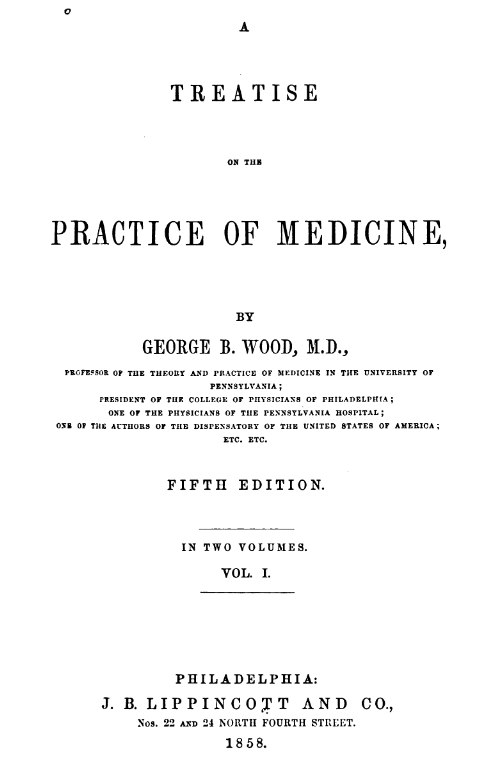
Textbooks assigned at Yale School of Medicine also expressed the belief that a person’s race could protect them from certain diseases while making them more vulnerable to others. For instance, George Bacon Wood’s A Treatise on the Practice of Medicine described inflammation as “more frequent in the black than in the white,” stated pneumonia was “very common among the black and coloured population of the South,” and explained that in the case of yaws (a skin disease), “Children are most susceptible to the contagion; and negroes are said to be more so than whites.” Wood did not support these brief mentions with evidence of why or supply a larger theory of the relationship between race and disease, but he assumed that such a relationship existed and, by including it in a medical textbook, made it part of accepted medical knowledge. Wood’s textbook also used its description of scrofula to give medical support to the socially accepted “one-drop rule,” that assumed that a person with any Black parentage was also Black, stating without explanation, “the negro, or person of mixed blood between the negro and white, is much more subject to it [scrofula] than the pure white.”
Wood also linked Black health to specific climates, suggesting they were naturally unhealthy in the cooler U.S. North. He explained that “Negroes, from their greater susceptibility to cold than the whites, are much more subject to phthisis in cold or temperate climates” and that “Negroes are, in this climate [Philadelphia, where he lived], more disposed to the disease [of tuberculosis] than the whites.” The association of Black health with warm places such as the U.S. South and Caribbean was commonly used to support slavery and the removal of free people of color from the United States to places like the colony of Liberia in Africa. By invoking this idea as poor Black health in the North, Wood tacitly supported slavery and Black removal, and he gave the idea added credibility by including it in a medical textbook.
In fact, the idea that Black people were innately suited to hotter places transfused the Medical Institution’s curriculum. In a chemistry lecture on color and the attraction of heat to darker ones and unrelated to anatomy or people at all, professor Benjamin Silliman posed the rhetorical question “Why do Black people endure heat better than cold.” as one in a series intended to explain his larger point about color and heat. Silliman use of this racial presumption assumed that students would relate to and readily understand it, indicating that he understood the belief in race specific fitness for climates to be widespread.
The idea that Black people were healthier in warmer places was also reflected in writings on “tropical” diseases such as yellow fever and malaria. Historians have long pointed out that enslavers used Africans’ supposedly lesser morbidity and mortality in plantation environments to defend slavery, but references to race and slavery do not appear in Yale Medical School notes on these topics. Nevertheless, students learned racial interpretations of these diseases from both assigned textbooks and works they read as part of their thesis research. The term “tropical medicine” had yet to be invented in the first half of the nineteenth century, and classifications of disease differed from modern ones. While yellow fever had been named, it is nearly impossible to know if what nineteenth century writers described would always fit our modern definition. Even more confusingly, malaria was not yet the name of a disease but rather described “bad air” that could cause disease. Historians believe that historical references to “remittent fever” generally correspond to what we would call malaria today and that sometimes “intermittent fever” also described the same disease. In fact, nineteenth-century medical writers often disagreed on the relationship between yellow, remittent, and intermittent fevers, sometimes arguing one type of fever could turn into another under certain conditions and other times arguing that they were distinct.
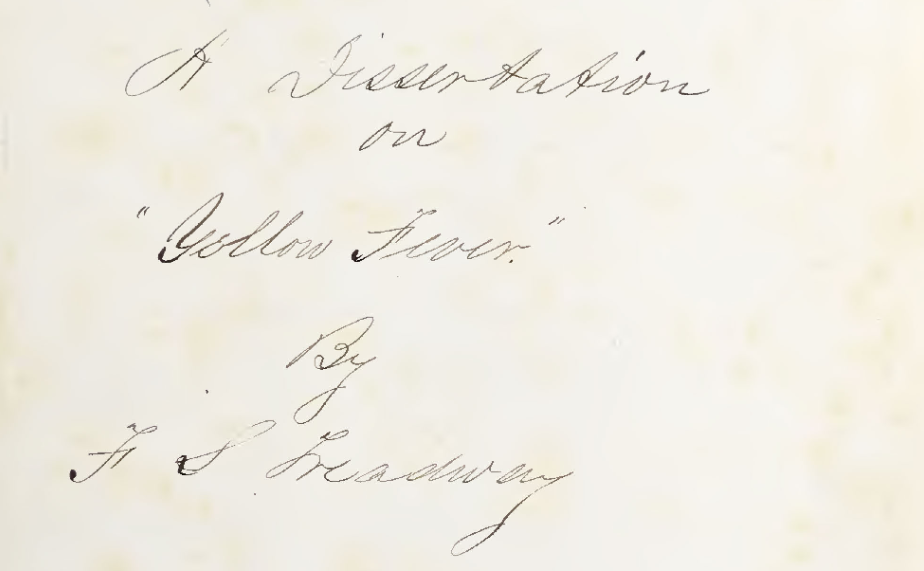
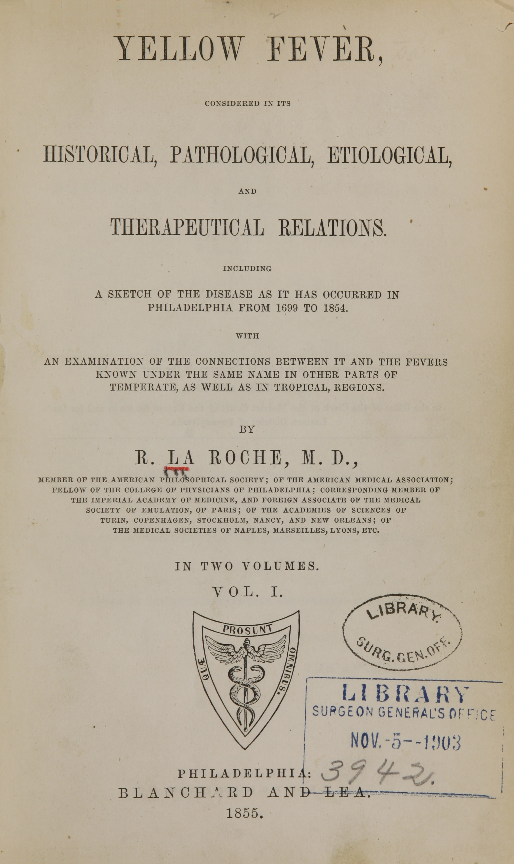
One Yale medical student, Frederick Treadway, wrote his MD thesis on yellow fever in 1863, in the middle of the Civil War. Treadway summarized contemporary knowledge of yellow fever, writing “Most writers on the subject, agree that in comparison with other with other races, the negro is least liable to be attacked with the disease. In this country, this exemption is in direct ratio, to the amount of African blood, the more the Caucassian [sic] the greater the liability.” This conclusion is especially striking because the one authority he cites, Philadelphia physician Réne La Roche, seems to have moved from not considering race in his writings on yellow fever to thinking it was a crucial element.
La Roche, Treadway’s source, virtually ignored the impact of race on yellow fever in an 1853 article but then made a robust case for the disease’s differing racial effects in a two volume work he published in 1855. LaRoche’s article argued that yellow fever was caused by local “sources of malarial infections” and was not “transmissible from one individual or place to another,” and the book made the same argument. In the article, La Roche mentioned race only briefly. He cited an instance where “black recruits from the coast of Africa” did not catch yellow fever when the crew of the ship they were on did, which La Roche interpreted as evidence that the “black recruits” did not bring the disease aboard. La Roche also mentioned that a case where “Europeans, newly arrived in a tropical climate” did catch the fever, but he did not draw any racial conclusions, focusing instead on where people came from rather than their race. However, La Roche’s 1855 two volume work on yellow fever that contained fifteen-hundred pages made an explicit case for the role of race in affecting yellow fever. In a chapter subsection entitled “Race,” La Roche contended that “Experience everywhere teaches that the disease [yellow fever], without completely sparing… the individuals of African birth or origin… affects more generally and severely the white race.” Effectively, he argued that both Black and white people could catch yellow fever and that time in cooler and temperate areas made all people more susceptible. La Roche ultimately concluded, however, that “the negro is enabled to enjoy a comparative exemption from fevers of all grades arising from malarial exhalations.” Here La Roche made one of the strongest possible claims of innate racial difference by specifically excluding other potential factors that might have granted people protection from yellow fever. Though there is no way to know for sure, Treadway likely read and regurgitated this second, explicitly racist study of yellow fever.
Treadway would have also learned that a person’s race mattered to how affected they were by yellow fever from one of his assigned textbooks. In Wood’s textbook that was required reading when Treadway was attending Yale, Wood, like La Roche, explained that “Negroes are certainly much less under the influence of the morbific cause [of yellow fever] than the whites. They are not only less frequently attacked, but are also more mildly affected when attacked. This relative impunity does not extend equally to those of mixed blood, who seem to be susceptible in proportion to their approach to the white.” Treadway, like many other medical students, learned or had reinforced that race mattered to medical diagnosis and treatment while earning his medical degree.
Overt racial assertions were not required to be a nineteenth-century doctor. Some Yale medical students who wrote their theses about remittent and intermittent fevers associated those fevers with southern heat and repeated the belief that the fevers affected Black people less than white people, much like Treadway did in his thesis on yellow fever. They, too, learned about this supposed connection from textbooks assigned at Yale and from other medical texts they cited in their theses. However, other students, including those from areas associated with the illnesses, instead focused on specific environmental causes and treatments while blaming them on personal behaviors and ignoring race as a potential diagnostic category. At least one textbook also refused to mention race when describing “bilious remittent fever.” We cannot know whether these students and the textbook’s author who chose not to mention race did so for personal reasons or ones rooted in their professional opinions, but the fact that they did not connect race to fevers demonstrates that some physicians did not blindly follow their training and assume, or at least they did not stress, that racial difference mattered to diagnosing and treating disease.
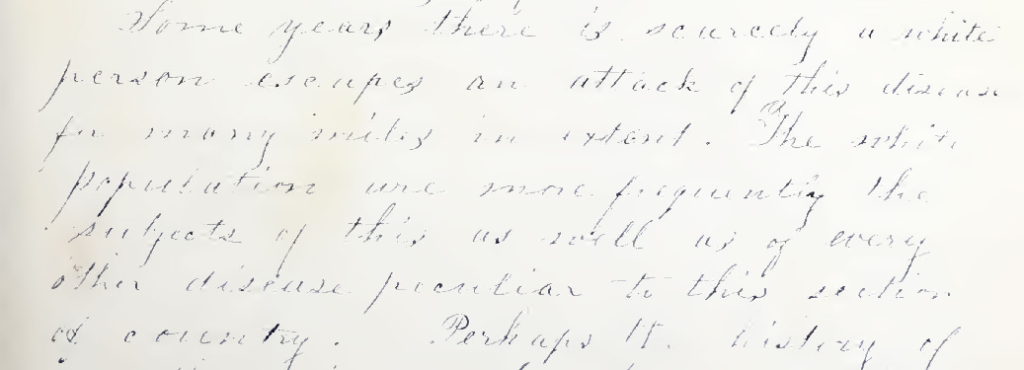
In 1842, Philo Nichols Curtis wrote his thesis on intermittent fever and remarked on its special threat to white Americans. He explained that the fever “demands a careful & attentive investigation by every physician in our country; but more particularly those of our Southern & Western States.” Curtis then justified this judgement by stressing that in “Some years there is scarcely a white person escapes an attack of this disease… The white population are more frequently the subjects of this as well as of every other disease peculiar to this section of country.” Curtis came to Yale from nearby Newton, Connecticut, and may not have visited the West or the South before describing the prevalence of fever there. Instead, he likely learned about the regional and racial differences as contemporary common sense, reinforced by reading he did for his thesis. Curiously, the expert on intermittent fevers that Curtis cited, Jean-Louis-Marie Alibert, stressed climatic causes and did not mention race as protecting anyone. Alibert did write that the fever “seldom attacks any persons but Europeans who visit the West Indies,” but he did so in the context of suggesting all “native inhabitants are generally exempt from it” and blaming “the influence of the atmosphere” on “strangers.” Alibert’s translator and editor further stressed the climatic aspect, arguing that “The pestilential endemic of the West-Indies spares the natives of those islands, as well as foreigners long accustomed to the climate, and confines itself to persons lately arrived from higher latitudes.” Essentially, Alibert and his translator believed people from Europe were at risk of catching intermittent fever because they were new to a hot place, not because of their race. Curtis’s choice to mention race as a risk factor is all the more striking when his source material did not.
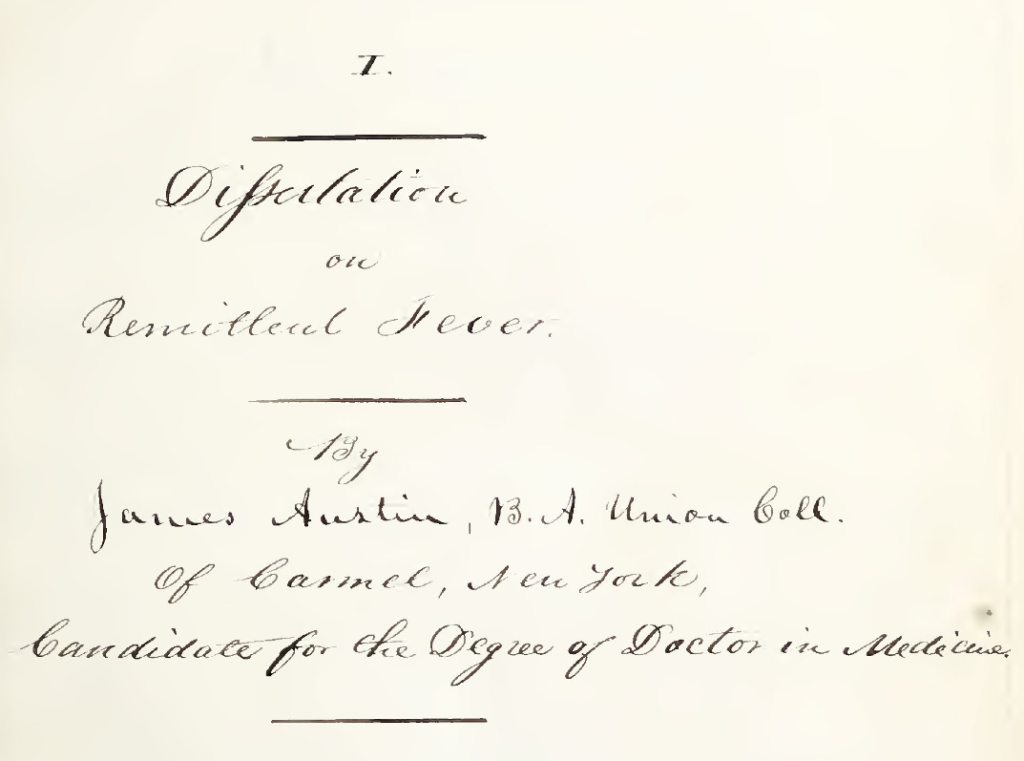
Other students did not follow Curtis’s choice to mention race in their theses on remittent and intermittent fever. This decision is similarly striking, however, because some cited experts that did highlight racial differences. James Austin, James Hyatt Harriott, and Henry Williams Foster all wrote theses on intermittent and remittent fever that did not mention race as an inciting or protecting factor. They did, however, associate the fevers with hot places such as the U.S. South even though Harriott was from Turks, West Indies, and Foster was a Black student from Liberia, Africa. Harriott’s thesis focused on the diagnosis and treatment of fever in individual patients, while Foster’s focused on how the specifics of location and individual behavior contributed to it. Austin, instead, repeatedly and broadly indicted “hot climates” and “heat” in general for acting as a “predisposing… cause,” despite avoiding the topic of race. However, two of the physicians that Austin cited mentioned climate and heat as a cause of fever but also repeatedly discussed the impact of race. One mentioned that “negroes… resist[ed] the causes of fevers… [and] suffer[ed] infinitely less than the Europeans” but vacillated between suggesting this was due to the “habit” of living in the climate and implying innate differences that allowed them “to do whatever duty or hard work was to be done in the heat of the day, from which they do not suffer, though it would be fatal to Europeans.” Another of Austin’s sources remarked “that white people cannot communicate certain contagious fevers to blacks. And… there are among the negroes many contagious febrile complaints, to which white people are not subject.” This second source further explained that while “It was observed, that negroes are not subject to the yellow and some other fevers,” though adding that those “who have been in Europe, or the higher latitudes of America, are subject to the yellow fever” and “that people of different shades between white and black are as subject to the fevers of white people as these themselves are.” Austin’s choice to not discuss race is striking in the context of his sources that discussed but equivocated on the issue. Austin, like Harriott and Foster, thought that a study of the causes and treatment of remittent and intermittent fevers did not need to reference race, and the Yale medical faculty agreed enough to grant them their degrees based on these theses.
As we have seen, Hubbard’s references to enlarged “Hottentot” breasts and labia that began this essay were not outliers in medical lectures, assigned textbooks, or student theses at Yale. Racial differences were assumed to be medically significant in many ways, from anatomy to disease susceptibility and treatment. Significantly, other professors followed Hubbard in specifically referencing non-white people when discussing sex and genitalia, even while most case studies in their lectures involved white patients. Professors rarely mentioned a patient’s race at all, in fact, but when they did, it was nearly always to mention that the patient was Black. This reveals that the medical school’s lecturers presumed a normative white body, meaning they understood people of other races to be deviations from ordinary, presumably healthy whiteness. But their stress on non-white examples when discussing sexual activities and anatomy reveal that the topics were taboo and part of exoticizing or “othering” people who were not racialized as white.
Following his discussion of “Hottentot” sexual traits, Hubbard also immediately drew on foreign examples when discussing male genitalia, again implying sexual difference with people racialized as something other than white. As part of his lectures, he discussed “a person of great distinction in China” who had a 70 lbs. tumor removed from his genitalia in London, but who died following the operation. This example was dramatic and on topic enough to be included in medical lectures on tumors of male genitalia, but its close proximity to his discussion of “Hottentot” sexual traits reveal an imagined connection between these quasi-sexual topics and racialized foreign “others.”

Hubbard was not the only professor who interlinked discussions of sexual and racial traits. In his first year teaching at Yale, Hubbard’s predecessor, the previous Professor of Surgery Nathan Smith, gave an unusual lecture related to sexual desire, sexual activity, and marriage. He explained that “It makes no difference who we cohabit with; I mean the [sexual] pleasures are the same, black or white; but it makes a material difference with whom we marry.” This juxtaposition seemed to imply that Smith acknowledged and perhaps even preferred interracial sex while condemning interracial marriage. By specifically mentioning interracial sex and reproduction in a medical lecture, Smith used his authority to reinforce the contemporary racial idea that people of African descent were more libidinous and therefore more available for sex outside of the cultural norms of marriage.

Both Hubbard and Smith linked non-white people with sexual traits that “othered” them. Both professors as well as their students assumed their medical subjects were white, unless they specified otherwise, but they purposefully discussed non-white examples when discussing sex and sexual traits, linking these people to the taboo and different.
Ultimately, the persistent use of racialized descriptions of patients and their associations with different diseases reveals the importance of race to physicians at Yale and beyond in the first half of the nineteenth century. Their sporadic use in medical course lecture notes and textbooks demonstrates not just that these were widely held ideas that needed little proof to support them but that medical students were taught that they mattered to disease diagnosis and treatment. Though some students chose not to repeat them in their theses, ideas of racial difference were prevalent in a Yale medical education.
Further reading
- Rana A. Hogarth, Medicalizing Blackness: Making Racial Difference in the Atlantic World, 1780-1840 (Chapel Hill: The University of North Carolina Press, 2017).
- Peter McCandless, Slavery, Disease, and Suffering in the Southern Lowcountry (Cambridge: Cambridge University Press, 2011).
- Jennifer L. Morgan, Laboring Women: Reproduction and Gender in New World Slavery (Philadelphia: University of Pennsylvania Press, 2004).
- Dorothy Roberts, Fatal Invention: How Science, Politics, and Big Business Re-Create Race in the Twenty-First Century (New York: The New Press, 2012).
- Harriet A. Washington, Medical Apartheid: The Dark History of Medical Experimentation on Black Americans from Colonial Times to the Present (New York: Doubleday, 2006).
- Christopher D. E. Willoughby, Masters of Health: Racial Science and Slavery in U.S. Medical Schools (Chapel Hill: The University of North Carolina Press, 2022).
